The Rideau Today and Yesterday
While most of this article has been looking back at the pre-canal Rideau, discovering “what did the Rideau look like prior to the canal being built?” we can turn that question on its head and ask “what can we see today that explorers would have seen in the pre-canal era?” Some of the physical attributes of the pre-canal Rideau, such as drowned forests and river channels have been discussed, but there is something else. A painting by George Seton holds the clues – it’s the wildlife.
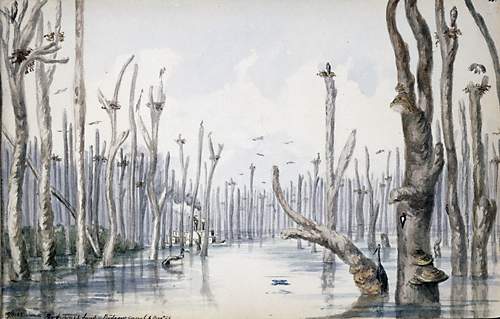 |
The Drowned Land 1844
This is likely a view of the River Styx. The steamboat “Hunter” is making its way along the navigation channel with the drowned trees of the surrounding forest on either side. Wildlife such as herons, ospreys and woodpeckers are putting these dead trees to good use as nesting locations and a source of food. Below the water, fish species, such as largemouth bass, are also taking advantage of the habitat these dead trees provide. “The drowned land - Rideau Canal 4 Augt 44,” by George Seton. Library and Archives Canada, 1950-63-1.18R
|
Seton did this painting of the River Styx in 1864 based on a sketch he did in 1844. In it he shows Blue Herons, Ospreys and (mistakenly) a red-headed woodpecker. Today we can see those same herons, ospreys and pileated woodpeckers, all of which would have existed in the pre-canal era.
We also know that loons existed in the pre-canal lakes. John MacTaggart, when describing how they were lost during a survey in the Drowned Lands (present day area of Whitefish Lake to Cranberry Lake), stated “We hallooed out frequently as loud as we could, but no one heard us. We were sometimes answered by the owl, afar in the solitary woods, and the lake bird, called loon, also deigned to reply from the distant waters.” (Three Years in Canada, Vol. 1. 1829, pg. 56). We know that there were ducks in the lakes – although as evident in one period painting, ducks were more appreciated as something to add to the dinner menu than for their wild beauty. Many other types of wildlife that we can see today such as turtles, raccoons and otters would have been seen back then, just as we can see them on the Rideau today.
While there are few references to the beauty of nature in the old reports, surveyor John Burrows did have a bit of the poet in him. After camping overnight at Davis’ Rapids, Burrows and his survey party headed south by canoe in the light of early morning, into Sand Lake, which Burrows in his 1827 diary called “Davies Lake.”
“The view of Davies Lake is very pleasing. The many islands, as if floating on a transparent mirror which mellowed and reflected by the tint of the morning, strikes the contemplative mind with a sensation of pleasure not easily forgotten” (Sights and Surveys by Edwin Welch, p.25).
Even though the landscape has changed, Burrows appreciation of the Rideau in 1827 is something that we can still share today.
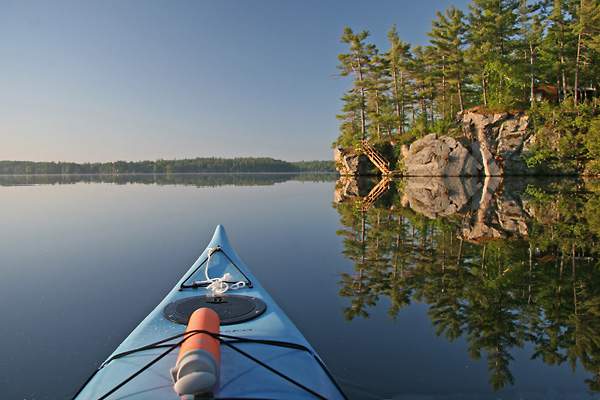 |
The early morning “Transparent Mirror” of Sand Lake in 2005
Sand Lake, which surveyor John Burrows called “Davis Lake” in 1827, can be appreciated today, much as Burrows obviously appreciated its beauty in 1827. Photo by Ken W. Watson, 2005
|
|