Your location: Rideau Canal Home Page > Fishing Information
Fishing Information
"Black and green bass are as plentiful here as pollywogs in a rain barrel."
quote from "The Picturesque Rideau," 1898.
The lakes and rivers of the Rideau Waterway offer great fishing opportunities. Species caught along the length of the Rideau Waterway include Largemouth Bass, Smallmouth Bass, Northern Pike, Lake Trout, Yellow Perch, Black Crappie, Muskellunge, and Walleye. In this part of the Rideau website you can check out:
Prior to any fishing adventure you should pick up the full Ontario Sport Fishing Regulations summary. These can be obtained on-line by going to MNR's Fish Ontario website at:
www.ontario.ca/document/ontario-fishing-regulations-summary
They are also available at most sports/fishing stores in Ontario, from the Ontario Ministry of Natural Resources (call the Natural Resources Information Centre at 1-800-667-1940 (francais: 1-800-667-1840) or (416) 314-2000 (Toronto) or (705) 755-2000 (Peterborough)).
You should also note that Ontario offers two types of fishing licenses, a standard licence and a conservation licence. The basic difference is that a conservation licence is cheaper but has a lower catch limit.
Please note that the following information is presented as a general guide only (and could contain errors) - please consult the MNR Fishing Guide for specific details.
Fishing Season:The Ministry of Natural Resources has a rather complex zoning system for fishing, however the following summarizes some of the key points for the Rideau region (Zone 18). Prior to embarking on a fishing adventure, be sure the read all the regulations (available on the MNR website, see below) carefully:
| Species |
Season |
| Bass* (Largemouth & Smallmouth) |
3rd Saturday in June to December 15 |
| Walleye ( Pickerel) |
Jan 1 to March 1
and 2nd Saturday in May to Dec. 31 |
| Northern Pike |
Jan 1 to March 31
and 2nd Saturday in May to Dec. 31 |
| Lake Trout |
4th Saturday in May to Sept. 8 |
| Muskellunge |
1st Saturday in June to Dec. 15 |
| Perch, Crappie, Sunfish, Whitefish, Catfish |
open all year |
* It is illegal to fish for Bass (or any other species) before the season opens, even if you are going to release them. It is especially damaging to bass during the spawning and rearing season in the spring. When adult bass are removed from their nests the eggs and young bass are left unprotected and subject to predation.
Fish Catch and Possession Limits (standard licence):
| Species |
Catch & Possession Limits* |
| Bass (Largemouth & Smallmouth) |
Six (6) per day |
| Northern Pike |
Six (6) per day |
| Walleye |
Four (4) per day
(must be between 40-50 cm / 15.7-19.7in) |
| Lake Trout |
Two (2) per day |
| Crappie |
Thirty (30) per day |
| Whitefish |
Twelve (12) per day |
| Catfish |
Twelve (12) per day |
| Muskellunge |
One (1) per day (min size = 91cm /36 in.) |
| Perch & Sunfish |
Fifty (50) per day |
Conservation Licence holders have a daily catch and possession limit of two (2) Pike, two (2) Walleye, two (2) Bass, ten (10) Crappie, twelve (12) Whitefish, one (1) Lake Trout and zero (0) Muskellunge.
* Note: The catch limit is the number of fish you are allowed to catch and keep in one day. Fish eaten for shore meals are included in the daily catch limit. The possession limit is the number of fish you are allowed to have on hand, in cold storage, in transit, etc. In this area the possession limit is the same as one day's catch limit.
Fishing Licence Costs:
Please visit MNRs Fish Ontario website www.mnr.gov.on.ca/en/Business/LetsFish/index.html for up to date pricing.
STOP Using Lead Tackle
Lead tackle can have harmful effects on local wildlife. A loon can die from lead poisioning with the injestion of a single small lead sinker. Please get rid of any tackle that contains lead and replace it with a lead free alternative (many of those available these days)
For more information, including an offer of a $10 voucher your old lead tackle, see: Fish Lead Free (external website)
STOP Using Regular Hooks
The biggest cause of bass mortality on the Rideau is gut hooking the fish. This most often happens when kids are fishing with a bare hook baited with live bait (i.e. a worm). STOP using regular hooks and switch to Circle Hooks. Circle hooks have two benefits, they actually catch more fish and the fish rarely swallow the hook (due to the shape). The use of circle hooks or lures (which also don't tend to gut hook the fish) will reduce bass mortality with catch and release. Circle hooks are available at any tackle store.
Bass Sign & Brochure
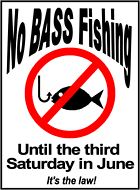 Bass are particularly susceptible to pre-season fishing which can cause significant damage to fish stocks (catch and release is as bad as catch and keep). To find out why and what you can do have a look at the Bass Out of Season Brochure an Adobe PDF document that you can view, save and/or print. Bass are particularly susceptible to pre-season fishing which can cause significant damage to fish stocks (catch and release is as bad as catch and keep). To find out why and what you can do have a look at the Bass Out of Season Brochure an Adobe PDF document that you can view, save and/or print.
Remember, Bass season doesn't start until the third Saturday in June. To remind people of that fact you can also download a sign showing this. Print it out on your printer and post it at the end of your dock (or local boating access point).
The Sport of Fishing
A true sportsman respects the prey he is after. In the case of fishing, it mean having fun catching fish and making sure that the fish, not caught for the purposes of eating, are returned to the water unharmed. There are a few guidelines that you should follow to ensure that generations to come can enjoy the same quality of fishing we do today.
Use barbless hooks - A skilled fisherman can catch as many fish on barbless hooks as he can on barbed hooks. It makes fishing more fun because you have to pay a bit more attention to line tension and the way you bring in the fish. It puts more sport into fishing. It is particularly critical to use barbless hooks if you plan to catch and release. The fish stand a much greater chance of survival. You can create your own barbless hooks in a few minutes using a file on your existing hooks. Be kind to the fish and go barbless.
Use non-lead weights and jigs - lead fishing gear has a detrimental impact on waterfowl such as ducks, geese, swans and loons. Some birds will pick up lead weights and jigs from the bottom as they scoop up pebbles to help grind their food. Others, such a loons, can swallow lead when they eat fish with lead sinkers or jigs attached.
When you dispose of your old gear, do it onshore, in a proper disposal area (garbage, local hazardous waste disposal area). When you buy new sinkers and jigs, make sure they are made out of non-toxic materials such as tin, bismuth, steel, or special putty. If your tackle shop doesn't have any, ask that they get some in.
Helpful Tips on Releasing Fish
Be gentle: rough and repeated handling destroys the slimy protective coating on fish. Exercise caution when removing the hook from the fish. When handling fish, do not squeeze or touch the gills. Grasp the fish just behind the gill covers and remove the hook as quickly as possible. Don't worry about whether your hands should be wet or dry - it's more important to be gentle.
Be quick: the shorter the time the fish is played, dehooked and released, the better its chances of survival.
Be kind: a fish out of water begins to suffocate and can injure itself while thrashing around. Even a few inches of water under a fish can reduce injury. A net can be used to keep the fish in the water. Remove the hook as rapidly as possible, preferably with long-nosed pliers. Don't tear the hook out. If a hook is deeply caught in the fish, and you must release it, cut the line and leave the hook in.
Be sensible: using barbless hooks and avoiding live or organic bait increases the chance of releasing your catch unharmed. Don't release bleeding fish or fish that are deeply hooked if they are within your legal limit. Their chances of survival are low.
Fish may lose consciousness and float on their side when returned to the water. By holding them upright, in a swimming position, and moving them slowly forward so water runs through the gills, fish get artificial respiration. Release fish when they begin to struggle. It may take a few minutes.
Be humane: fish are living creatures, respect them before and after they are caught. Proper care of released fish will greatly improve survival and help maintain a healthy fishery. It will also identify you as an angler who understands fish conservation.
BASS - A Special Word
Largemouth bass are homebodies. Tracking studies on the Rideau show that they stick close to their home and if moved, can take months or even years to return. It is very important that if you are doing catch and release, that you do it in the spot you caught the bass. DO NOT transport live bass away from the spot they were caught.
Remember the Future of Fishing is in your hands.
|
Fishing Links
MNR's Fish Ontario Website
Rideau Fishing Information Page
Friends of the Rideau Fishing Page
Fish-Hawk.net (good on-line local fishing maps of Rideau lakes and fishing tips)
Fishing Tips Guru
Comments: send me email: Ken Watson
©1996- Ken W. Watson
|