Newboro Lock 36
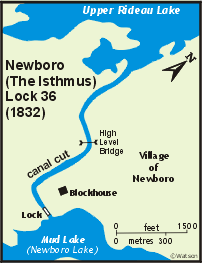
| location map | lockstation information |
The Setting
Known as the Isthmus, this was the height of land that, in the pre-canal era, separated the Rideau and Gananoque watersheds. Water to the north of the Isthmus flowed north into the Rideau River and down to the Ottawa River. Water to the south of the Isthmus flowed south through a series of lakes into the White Fish River, and from there to the Gananoque River. The mill dam at Morton (c.1805), later replaced by a canal water control weir (1831), switched the flow from the Gananoque River to the Cataraqui River. The width of the Isthmus was about 5,200 feet (1580 m) in a straight-line distance between Rideau Lake (now Upper Rideau Lake) and Mud Lake (now Newboro Lake - the original name comes from the depth of mud on the bottom of the lake). The highest elevation on the Isthmus was about 44 feet (13.4 m) above the level of Rideau Lake. Rideau Lake was about 5 feet (1.5 m) higher in elevation than Mud Lake. In the pre-canal era, a reported 2,400 m (8,000 ft) portage connected Rideau Lake with Mud Lake.
The Plan
By's original plan was essentially the same as Samuel Clowes' 1824 plan, to put a canal cut through the Isthmus, connecting Mud Lake to Rideau Lake. Mud Lake would be raised to the level of Rideau Lake by the dam and locks at Chaffey's Mills. The proposed route of the canal cut would follow the natural lay of the land, a distance of about 6,000 feet (1830 m). By following this winding route, it was estimated that a maximum depth of cutting would be 25 feet (7.6 m) (as opposed to 44 feet (13.4 m) if a direct line had been taken). If the canal had been completed to the original plan, there would have been a single body of water stretching from Chaffey's Lock to First Rapids, a huge reservoir that would have fed both the Cataraqui and Rideau sections of the canal.
Unfortunately the original plans were about to go badly awry. John MacTaggart would regret one of the statements he made in his 1827 survey report, to whit: "Throughout this line of proposed cutting, little rock is expected to be met with,…"
Building the Locks
The original contract was awarded to William Hartwell.
The story of the Isthmus is one of malaria and bedrock. The work in 1827 consisted of clearing the land along the line of the canal and starting the excavation work. Work by Hartwell did not progress at a very rapid pace, and By noted in January 1828 that he had warned Hartwell that he was not pleased and that if the work didn't improve, he would be forced to break Hartwell's contract.
It was Mactaggart who first indicated the seriousness of the bedrock problem: "The oftener I examine the excavation now in progress between Rideau Lake and Mud Lake the more I am convinced that it is going to turn out to be a more difficult piece of work than has been suspected. … I am sorry that when surveying this Isthmus last Summer [1827] we had not a set of boring tools to ascertain its nature more fully in consequence the estimate returned of this work will not I am afraid be sufficient unless some other method than the present be adopted …."
In the summer of 1828, malaria struck so severely that the work essentially came to a standstill. In October 1828, Hartwell wrote a letter to By requesting that he be released from his contract.
A new contractor was hired for the site, possibly one named Stevenson. In the summer of 1829, malaria again struck. Most of the labourers working at the Isthmus quit. By wrote; "such has been the Mortality occasioned by Lake fever that there is great difficulty in procuring workmen, in fact there is only 4 men on the Isthmus at the moment." The new contractor quit and it was at this point that By decided to use the 7th Company of Sappers and Miners, under the direction of Captain Cole. On January 1, 1830, Captain Cole and an advanced detachment arrived at the Isthmus. In February 1830, the rest of the 7th travelled to the site by sleigh. In 1830 there were 2 Royal Engineers, 1 commissariat official, 59 members of the 7th Company of Royal Sappers and Miners, and 250 labourers employed at the Isthmus. At one point during 1830 the labour force was as high as 600 as By strove to complete the works on time. Malaria took its toll; during 1830 some 14 men, 9 women and 9 children died from "Lake Fever."
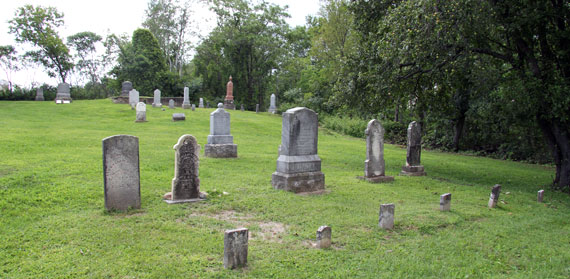 |
Royal Sappers and Miners Cemetery
This cemetery, originally called the “Military and Civilian Cemetery” started out as the burial ground for those that died at the Isthmus during the construction of the canal. It eventually became the Presbyterian Cemetery and saw continued use up until the 1940s. Most of the canal era deaths were due to disease. In 1830 for instance, of the 334 men at the Isthmus, 14 died of complications from malaria as did 9 women and 9 children. All would have been buried here. Contrary to popular belief, funerals were held for all those that died and their graves were marked with wooden markers, which have long since rotted away, leading the erroneous conclusion that they were buried in unmarked graves (or only marked with fieldstones which were likely footstones).
This cemetery also holds the graves of some of the Sappers and Miners who worked at this site. Of the 162 Sappers and Miners that worked on the canal, 22 died as a result of disease and work related injuries (16 from disease and 6 from accidents). About 60 were stationed at the Isthmus and 12 are buried here. When the canal was completed, 71 Sappers and Miners took land grants offered by Colonel By, many of these becoming the first lockmasters, including Corporal Daniel McDonald of the 7th Company who became the first lockmaster at Newboro.
The cemetery was renamed from the Old Presbyterian Cemetery to the Royal Sappers and Miners Cemetery in 2017.
photo by: Ken Watson, 2017 |
By 1830, By realized that something drastic had to be done to allow the work on the Isthmus to be completed on time. Surveys had indicated that he could not raise the level of Mud Lake, to reduce the depth of excavation through the Isthmus, with an additional height of lock at Chaffey's Mills. So instead he proposed to put in a lock at the foot of the canal cut (at Mud Lake) and at the same time put in a lock and dam at the Upper Narrows, to raise the level of the upper part of Rideau Lake by 4 feet, 10 inches (1.5 m) above the planned raised level of the lake from the canal dam at Poonamalie, which meant that much less excavation of the Isthmus canal cut. The raised water level in Rideau Lake also meant about 1,200 feet (366 m) less canal cut would be required due to the change in the position of the shoreline of the new Upper Rideau Lake.
By in his 1830 report stated: "In consequence of a much greater quantity of Rock occurring than at first anticipated, and the very great Sickness which prevails periodically at this Station causing a serious increase in the price of labour, together with the open nature of the Rock admitting water from the Lakes, occasioning a heavy expenditure in pumping, or an equivalent addition to the price of Rock per Cubic yard to cover the same, and as the quantity of water would necessarily augment as the Excavation became deeper, I considered it indispensably necessary to deviate from the original Plan, and have therefore backed up 4 feet of Water, by placing a Lock and Dam at the Narrows, and to surmount this additional rise, it being impracticable to raise the Water of Mud Lake by increasing the lift at Chaffeys Mills with Safety, a Lock of 4 feet if it is placed at the end of the Excavation at the Isthmus entering Mud Lake, and should it be found advisable at any further period, on the Country becoming more healthy, to deepen the said Excavation, as originally proposed, it can be done, and there being no Breast Works to the Two Locks above mentioned they will then Serve as Guard Locks."
 It is interesting to note that By considered that the Isthmus cut might be deepened at some later date, removing the need for the locks at Newboro and Narrows, and returning the waterway to his original concept of a single reservoir of water from Chaffey's to Poonamalie. Not everyone agreed with Colonel By's final plans. Lieutenant Frome in his report felt that it would have been preferable if a second lock, with an 8 foot (2.4 m) lift had been placed at Chaffey's Mills, and that instead of a lock at the Upper Narrows, that the lift (4 feet 10 inches - 1.5 m) be added to the lock and dam at First Rapids (Poonamalie). Frome notes, "Some low ground must of course have been flooded by this plan, both on the shores of the Lower Rideau and Mud Lakes, but it is of little value, when compared with the saving it would have occasioned." It is interesting to note that By considered that the Isthmus cut might be deepened at some later date, removing the need for the locks at Newboro and Narrows, and returning the waterway to his original concept of a single reservoir of water from Chaffey's to Poonamalie. Not everyone agreed with Colonel By's final plans. Lieutenant Frome in his report felt that it would have been preferable if a second lock, with an 8 foot (2.4 m) lift had been placed at Chaffey's Mills, and that instead of a lock at the Upper Narrows, that the lift (4 feet 10 inches - 1.5 m) be added to the lock and dam at First Rapids (Poonamalie). Frome notes, "Some low ground must of course have been flooded by this plan, both on the shores of the Lower Rideau and Mud Lakes, but it is of little value, when compared with the saving it would have occasioned."
The lock was built on a rock foundation, without breastworks. Instead of using tunnel sluices, sluice valves were placed in the upper gates. The upper sill was placed at the same elevation as the lower sill, anticipating that at some point, the canal cut might be excavated to its originally proposed depth, doing away with the need for the lock.
A blockhouse was built here in 1832-33, one of only four built along the Rideau. It was built by contractor William H. Tett. It is a small blockhouse, 24 feet (7.3 m) on a side, designed for 20 men, consisting of a masonry base, with a framed wooden upper storey. The base had a thickness of 3 feet (0.9 m) at the bottom, tapering to 2 feet (0.6 m) at the top. It was built with sandstone blocks, with granite blocks at the corners and sandstone rubble in between. There were originally no openings other than protected air holes in the masonry lower floor. Access was through a trap door from the upper storey. The upper storey was 28 feet (8.5 m) on a side, and built of eastern white pine timbers, 15 inches (0.4 m) thick by 14 to 19 inches (0.4 - 0.5 m) high. Access was by an external stairway to a door. The roof was shingled with cedar shakes.
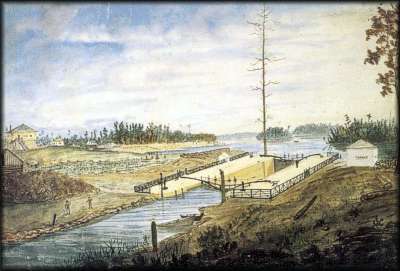 |
Lock, &c at the isthmus, the last ascent to the Summit Water of the Canal from Lake Ontario; 1841
Thomas Burrowes, watercolour, Archives of Ontario
View of the lock at the Isthmus looking out into Mud Lake. The blockhouse is visible on the left. The two posts located on either side of the lock at the near end are attached by ropes to a flood safety gate. This gate was designed to automatically pivot upwards in the event of a flood or the failure of the lock gates (which would have drained Upper Rideau Lake into Newboro Lake). It lay flat on the floor of the channel and could also be manually raised into place using the posts and ropes. |
Through the Years
This lockstation was known as The Isthmus, until it was replaced by the name of the local town, Newboro, in the 1860s.
The depth and width of the canal cut gave problems over the years. In 1887, the level of water in the cut fell to 4 feet 6 inches (1.4 m). Finally in the mid 1890s the bottom of the cut was blasted out for an additional depth of 18 to 24 inches (0.5 - 0.6 m).
Normal maintenance was done on the lock. In 1877 it was reported that leakage from the upper wing wall was sufficient to fill the lock in 20 minutes. The lower gates were kept closed as much as possible to hold back water during that season. At the end of the season, clay puddle was added behind the upper wing walls, and the walls themselves were partially rebuilt. In 1900 the west lower wing wall had to be rebuilt with stone from the quarry in Elgin. In 1909-1910 the whole of the lock underwent major repairs and renovations.
The lock was electrified in the spring of 1966. The hand operated wooden gates were replaced with steel gates, opened and closed using electric powered hydraulic rams. Work on this progressed at a slower pace than anticipated and the lock didn’t open until June 15 of that year. Newboro was one of the busiest locks on the system, and it was felt that electrification would make the locks more efficient. Newboro was just the first lock to be electrified, the Department of Transport had plans in place to electrify the whole of the Rideau. This met with a flurry of protest from residents and concerned groups who felt that electrifying the locks would forever compromise the historic integrity of the Rideau. Eventually, those concerned with protecting the heritage of the Rideau won out and only two other locks, the lock at Black Rapids, and the new combined lock at Smiths Falls were ever electrified.
The blockhouse never had to serve its military purpose. It is possible that during the rebellion crisis of 1837-38 members of the second regiment of Leeds Militia may have stayed in the blockhouse. They were stationed at Newboro, but the old Sappers and Miners' barracks were still standing, so it is likely that most of them stayed in the barracks. By 1856 the blockhouse was serving exclusively as the lockmaster's house. In 1888 it underwent extensive renovations. Large framed additions were added to it, giving it the appearance of a farmhouse and all but obliterating any visible evidence of the blockhouse. It stayed like that, deteriorating over the years, until abandoned in 1962.
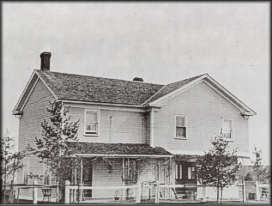 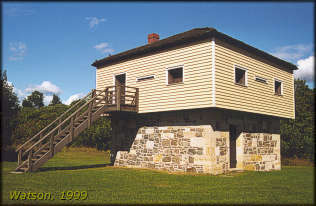 |
Lockmaster's House (Blockhouse) as it looked in 1930 and as it looked in 1999
1930 photo: Parks Canada, DIAND - 1999 photo: Ken Watson
(can you see where the original blockhouse is in the 1930 picture?) |
The Department of Transport planned to sell off or demolish the building, however the Historic Sites Branch of the federal government argued that it should be preserved. By 1965 there was much interest between federal and provincial authorities to make the Rideau a heritage waterway. The Department of Transport decided at that point that it should restore historic works as funds became available. In 1967 and 1968 the blockhouse underwent extensive renovations. The old wood "farmhouse" framing was completely removed. The upper timber storey was dismantled. The lower masonry storey was repaired and a door put in. The upper storey was rebuilt, with B.C. Fir replacing some of the original timbers that could not be salvaged.
The Lockmasters to 2000
The first lockmaster was Daniel McDonald, a corporal in the 7th Company, Royal Sappers and Miners, who was recommended for the position by Colonel By. In 1847 he became temporary Foreman of Works and was replaced by Daniel Buck and then in 1848 by A. Sands. He returned as lockmaster in 1854, retired in 1856 and was replaced by William G. Addison. Addison transferred to Long Island in 1862 and was replaced by the Long Island Lockmaster, David Forster. Forster died in 1864 and was succeeded by his son, Alfred Forster who was 16 years old at the time. Alfred transferred in 1871, exchanging positions with Locksmaster John Johnston of Davis Lock. Johnston retired in 1887 and was replaced by William G. Dargavel who retired in 1921. Dargavel was followed by John (Jack) Lyons from 1921 to 1946; H.E. King from 1947 to 1961; Eldon Austin Mavety from 1962 to 1971; R.J. Hamilton in 1972; Lorne Dyer from 1973 to 1984; Allan Blair from 1985 to 1986; and David Blair from 1987 to 2000.
|