Narrows Lock 35
| location map | lockstation information |
The Setting
Originally known as the Upper Narrows (to distinguish it from the Lower Narrows, the area now known as Rocky Narrows), this was a shallow, narrow section of Rideau Lake. At this time, Rideau Lake was one lake, stretching from the Westport area to First Rapids (Poonamalie). Samuel Clowes' 1824 survey indicated that the width of open water separating the north and south shores was 363 feet (111 m), however surveys in 1827 reported widths of only 100 to 150 feet (30 - 45 m). The depth of water in summer was about one foot (0.3 m), and it was commonly used as a ford. The length (along the line of the lake) of the shallows at Upper Narrows was estimated to be 250 feet (76 m) by MacTaggart, and 1,000 feet (305 m) during a later survey by Lt. Frome. The discrepancy in those numbers is likely simply due to the naturally fluctuating water levels of Rideau Lake.
The Plan
The original plan for this area was to excavate the rocky shallows at the Upper Narrows to form a navigation channel. The original plan also called for two locks at Chaffey's Mills in order to raise the water level in Indian, Clear and Mud (Newboro) Lakes to that of Rideau Lake. A canal cut was to be excavated through the Isthmus, the piece of land between Mud Lake and Rideau Lake (now Newboro Lake and Upper Rideau Lake). The end result of this work would have been to form a single body of water from Chaffey's Locks to First Rapids (Poonamalie). It would have been a huge reservoir, feeding both the Rideau River and the Cataraqui River systems. However, it didn't quite work out as By had planned.
By 1829 it was realized that the proposed canal cut in the Isthmus was going to be very difficult to excavate. Malaria was rampant and By was having a hard time keeping workers at the Isthmus. Hard bedrock was unexpectedly encountered, and it was proving slow, difficult, expensive and dangerous to blast through. A survey of the shoreline showed By that he could raise the level of Rideau Lake above the Upper Narrows by 5 feet (1.5 m) without overflowing the banks. By in his 1830 report wrote, "it appeared on clearing the Isthmus between the Rideau and Mud Lakes, and commencing the Excavations. that much more Rock occurred than was originally contemplated and the periodical Sickness which prevailed at that place, rendering it necessary to give a much higher rate of wages to the Labourers, as an inducement for them to remain at so unhealthy a Station; the removal of the Rock would have been attended with so great an increase above the original Estimate, that I considered it indispensably necessary to deviate from the original Plan, and to place a Lock and Dam at the Narrows to back up 4 feet of Water, thereby saving that Depth of Cutting in the Excavation alluded to - The Lock is 4 Feet Lift, without Breast Work, and the Dam which serves also as a Waste Weir, 10 feet in height, averaging 427 feet in length."
By also noted that by creating a head of water, he could release some it at intervals to scour the soft mud below (north) of the Upper Narrows "which impedes even Canoes and rise as the Water rises."
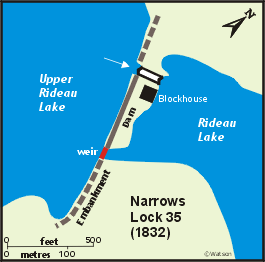
So, By's final plan by 1830 was to build a dam across the Upper Narrows with a lock, with a lift of 4 feet, 10 inches (1.5 m), and extend a dam and embankment along the southeast side. This dam and lock would form a new lake, now known as Upper Rideau Lake.
Building the Locks
 The original contract awarded for the clearing of a navigation channel at Upper Narrows was to William Hartwell. He was released from his contract in late 1828. The contract for the dam and lock was awarded to Bell, Richardson & Co. (contractor for Old Slys and Edmunds). The original contract awarded for the clearing of a navigation channel at Upper Narrows was to William Hartwell. He was released from his contract in late 1828. The contract for the dam and lock was awarded to Bell, Richardson & Co. (contractor for Old Slys and Edmunds).
The lock was built on a solid rock foundation. It was built without a breastwork, with gate sluices in both the upper and lower gates. The lack of breastwork allowed By to use wooden sills, made of oak, bolted to the rock, for both the upper and lower gates. Lt. Frome noted that "The original channel is here closed by a wooden waste-weir, and a lock of 4 feet 10 inches lift, built in a cut made through a narrow tongue of land. The foundation is a solid rock, which has been sunk 3 feet lower than was necessary." Frome here is referencing the fact that the lower sill at Narrows was excavated 3 feet deeper than necessary (it is 3 feet (0.9 m) deeper than the upper sill at Poonamalie - it should be at the same elevation as the upper sill at Poonamalie). Either someone forgot to take into account during construction exactly how much the dam at First Rapids (Poonamalie) was going to raise the level of Rideau Lake or they made a level error.
A dam was built on either side of the lock. On the south side, the dam stretched into an embankment, 758 feet (231 m) in length, required to contain the newly raised water in Upper Rideau Lake. A waste weir in the form of wooden sluices was put into the dam on the south side of the lock.
A blockhouse was built here in 1832-33, one of only four built along the Rideau. It was built by contractor William H. Tett. It is a small blockhouse, designed for 20 men, consisting of a masonry base, with a framed wooden upper storey. It was placed in a moat that may have originally been filled with water. A stairway from the embankment led to the second floor, the only access into the blockhouse. The roof was done with cedar shakes.
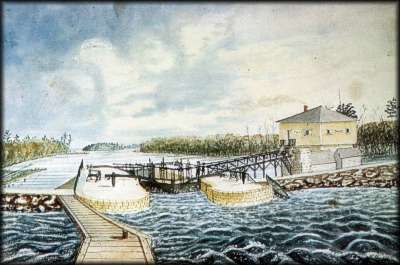 |
Lock, Blockhouse &c at the Narrows, Rideau Lake - the first descent from Summit towards Bytown; 1841
Thomas Burrowes, watercolour, Archives of Ontario
Looking towards Big Rideau Lake, the lock and dam at the Narrows hold back the waters of Upper Rideau Lake. A blockhouse stands guard over these works. Note the presence of rack and pinion gate sluice mechanisms in the upper gate, indicating that the Narrows lock was built without breastworks. |
Through the Years
The lock here underwent normal maintenance for wear and tear. In 1863, one of the wing walls was repaired. In 1885-86 both upper wing walls were rebuilt. In 1908 the lock was pumped out and both walls were re-laid.
The embankment was widened, and the waste weir was redone in concrete.
A ramp leading from the lock to the second storey of the blockhouse was added in 1836. Alterations were made later in the 19th century to make is more suitable as the lockmaster's home. This included a two-storey frame addition to the blockhouse. In 1967-70 the blockhouse was restored. The frame addition was torn down, the land around the blockhouse raised to the level of the dam, and a door cut in the masonry wall of the lower storey to provide access to public washrooms that had been installed.
In 1867, a wooden swing bridge was placed across the lock, to provide a road connection between the north and south shores of the lake. In 1964 this bridge was replaced by a manually operated steel truss swing bridge (that bridge was originally built at Beveridges in 1898 but was removed and brought to Narrows after a fixed bridge was built at Beveridges in 1961).
An astute observer might ask why, if the lock was originally built with a lift of 4 feet, 10 inches (1.47 m), it only has a lift of 2.6 feet (0.8 m) today. The answer lies with the weir at First Rapids (Poonamalie)? Problems with retaining sufficient water to supply navigation depth in the Rideau River system led to the raising of the weir height at Poonamalie over the years. The difference between the height of the original weir, and the height of the current weir (built in 1971) at Poonamalie is 1 foot, 4.6 inches (0.42 m). This increase in the height of the dam (and consequently the level of Big Rideau Lake) accounts for the drop in the lift at Narrows Lock.
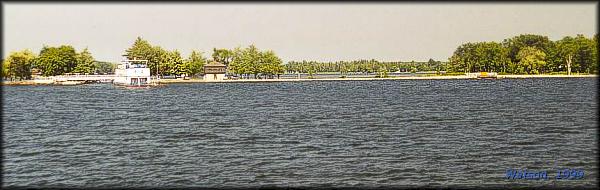 |
Narrows Lock, Upper Rideau Lake side
Swing bridge is closed, large cruise boat, "Kawartha Voyageur" is tied up at dock. Note the blockhouse at center left of photo, and the waste weir (yellow warning sign) on the right side of the photo.
photo by: Ken Watson, 1999 |
The Lockmasters to 2000
The first lockmaster was Archibald Sands, a corporal in the 15th Company, Royal Sappers and Miners, who was recommended by By in 1831. He retired in 1856 and was replaced by Michael Mooney, who retired in 1871. His successor was Henry Layng who left for Jones Falls after a couple of months and was replaced by Robert Bolton, who also transferred to Jones Falls in late 1871. Lock labourer, Michael Mooney Jr. (the son of previous Lockmaster Michael Mooney), took over as lockmaster in 1871, serving until 1894. He was replaced in 1894 by William Carty and then in 1895, Mooney Jr.'s son, Michael Edmund Mooney, temporarily took over as lockmaster for that summer. He was discharged late in 1896, but was reappointed as permanent lockmaster in 1897 and served until 1946. He was followed by T. King from 1947 to 1956; Jack Muchmore from 1958 to 1968; J.A. Gallerneault from 1969 to 1971; Gerald Hutchings from 1972 to 1979; Gord McVeety from 1980 to 1995; Herb Simpson from 1996 to 1998; Billy Glover acting from 1998 to 1999; and Bruce Haskins from 1999 to 2000.
|