A Rock For Dinner
by Ken W. Watson
It was February 1831, a beautiful winter day at Kingston Mills. The contractor in charge of building the locks and dam at this location, Robert Drummond, was sitting down for his noon meal at his house, located 600 feet (180 m) from the upper lock. His foremen had joined him, and, as usual, they were discussing the business of the day as they enjoyed a hearty meal.
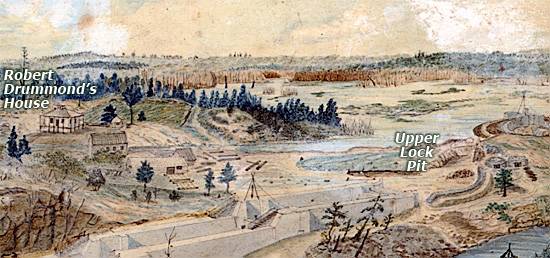 |
| Kingston Mills 1830 (looking north)In this cropped section of a c.1830 painting, we can see the relationship between the upper lock pit, the excavation of which was just starting, and Robert Drummond's house at Kingston Mills. The canal construction camp was part of a thriving community. A November 1830 census shows 101 buildings located at Kingston Mills, including three licensed public houses (O'Reilly's Franklin's and Mahoney's), a Catholic chapel, a store, and a schoolhouse [Patterson p.38]. "Kingston Mills: Masonry of three lower locks completed, Steamboat "Pumper" at lock entrance", by Thomas Burrowes, c.1830. Archives of Ontario, C 1-0-0-0-72. |
The only way to excavate the pit in the hard bedrock at Kingston Mills was to blast it. Holes were laboriously drilled using sledge hammers and hand drilling steel. Black powder was poured in and tamped down. A fuse was laid for each charge and the hole for the charge tightly sealed with clay.
A man, standing behind cover, blew hard on a horn, warning all around that the charges were about to be set off. A single man stood in the lock pit, his hand holding a red glowing torch. Only one man was allowed to light the fuses, everyone else was safely away from the pit.
As the final sounds of the horn echoed back from the hills, the man by the charges applied his torch to the end of each fuse. As the fuses started to smoke the man ran for dear life. One never knew exactly how long it would take each fuse to set off its charge, and learning from hard experience, whoever lit the fuses had to be nimble on his feet. A man of experience, our fuse lighter reached a safe place in good time.
Whomph – the charges went off.
In the meantime, as the fuses burned, Drummond and his men continued to enjoy their lunch. They were aware that blasting was taking place in the pit and that charges were set off with no fixed schedule. Whenever a set of charges were laid, they were immediately set off.
So, the sound of the warning horn, followed a few minutes later by the sound of the explosion, didn’t faze them a bit. But, right on the heels of the explosion, came a huge crash as a 700 lb (315 kg) rock ripped through the side of the house, narrowly missing the diners. Chairs were scattered as the men, somewhat dazed, unsure of exactly what had happened, scrambled to their feet.
The rock had made a hole in the side of the house, and now lay embedded in the floor. Drummond quickly took stock of the situation, seeing with relief that no one had been hurt. There was no point in berating the men who had laid the charges, blasting rock with black powder was an unpredictable affair. A few months before, a rock weighing about 20 lb (9 kg) had gone through the roof of his house. These things happened.
In fact, as the surge of adrenaline drained away, Drummond was more interested in finding out how a rock of that size and weight had been able to travel the 600 feet from the upper lock pit to his house.
During the building of the Rideau Canal, rock was excavated either by hand (pry-bars) or by using explosives. At the time of construction (1826-1832), the explosive in use was black powder (also known as gunpowder). Dynamite wouldn’t be invented (by Alfred Nobel) until 1866. Black powder is made up of a mixture of saltpeter (potassium nitrate), brimstone (sulphur), and charcoal. It is a “deflagrating” explosive, that is, it is a slow explosive when compared to today’s high explosives and blasting agents. When a black powder charge goes off, it takes some time to burn (in explosive terms) and heaves the rock, rather than shattering it.
Black powder was very dangerous to use for a number of reasons. The explosive force of the blast was difficult to determine. It depended on the amount of powder, the grain size of the powder, and the pressure under which the blast was initiated. A hole would be drilled using hand steel, the powder poured in, a fuse laid and the hole sealed. The idea was to confine the blast (pressure) in order to increase the force of the explosion. Today we can calculate the effect of a blast, but at the time of the building of the Rideau Canal, it was simply a guess. So, when a blast went off, no one really knew how much rock would be blown up, or how far that rock would travel.
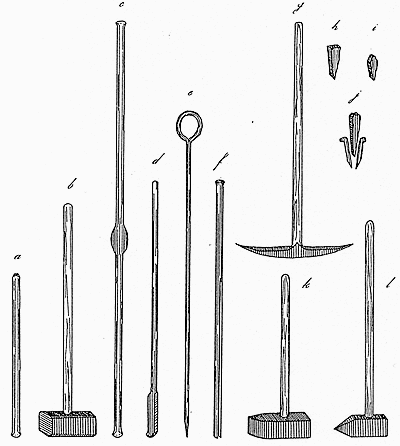 |
Miners Tools
a) Jumper (drill/boring tool)
b) Sledge Hammer
c) Hand Drill with bulb in middle to improve handling
d) Scraper (spoon) for removing cuttings from the hole
e) Needle for laying the charge
f) Tamping bar for tamping the charge
g) Pick for rock splitting and setting gads
h,i) Gads (wedges) for stone splitting
j) Wedge and feathers (plug and feathers) for stone splitting
k) Face hammer used for stone splitting
l) Scabbing hammer used for rough dressing stone
Illustrations by Suzanne Plousos from "Working with Tools," 1996.
|
Another problem with black powder is that it can be set off by a spark. Today’s explosives and blasting agents require a high explosive charge to set them off (i.e. a blasting cap) and most can actually be burned quite safely (they just burn, they don’t explode). Not so with black powder. An errant spark can set off a charge, so one has to be very careful with the transport of black powder and the setting of a charge.
A final problem is how to safely set off a charge of black powder. The fuses of the day were made using black powder, often a tarred hemp cover surrounding a line of powder. The grain size of the powder, the thickness of the powder in the fuse and the pressure it was under all affected the burn rate. The bottom line was that the burn rate was unpredictable. The earliest version of a “safety fuse” wasn’t invented until 1831.
A testament to the danger of black powder is the fact that at least five of the twenty-two Royal Sappers and Miners who died during the building of the Rideau Canal, died directly as a result of blasting accidents; two dying from “quarry blasts”, two from “blasting accidents” and one from “explosion.” These were men trained in the safe handling of black powder. But even with that training, black powder accidents happened.
Colonel By himself was no stranger to black powder. In 1812, he was appointed Commanding Royal Engineer of the Royal Gunpowder Mills in England. This occurred shortly after an explosion, in November 1811, killed eight men and seriously wounded one more at the Waltham Abbey Gunpowder Mills. Colonel By ended up designing some new presses for the mills and instituted several safety measures for the added protection of the mill workers. But even with By’s knowledge of black powder, blasting rock with gunpowder during the building of the Rideau Canal was a risky exercise.
John Mactaggart noted a problem encountered early on in construction, with some of the immigrant Irish volunteering to work in the quarry (because of the higher wages), despite their lack of experience:
"Some of these, for instance, would take jobs of quarrying from contractors, because they thought there were good wages for this work, never thinking that they did not understand the business. Of course, many of them were blasted to pieces by their own shots, others killed by stones falling on them. I have seen heads, arms, and legs, blown about in all directions ; and it is vain for overseers to warn them of their danger, for they will pay no attention. I once saw a poor man blow a red stick, and hold it deliberately to the priming of a large shot he had just charged. I cried out, but it was of no use. He seemed to turn round his face, as if to avoid the smoke; off went the blast, and took away his arm, and the half of his head : he was killed in a moment. As the blocks of stone fell, one of them broke the leg of another poor man, who knew nothing of such a shot being fired. At length we got the matter so systematized, that a number of shots were always prepared to be fired at once; a person stood at a distance, and kept blowing a horn, so that all the quarriers got out of the quarry to a respectable distance before the mine was sprung.
In spite of all precaution, however, they sometimes returned too soon, before some of the lazy shots had exploded, and so met with serious accidents ; and there always will be accidents taking place which cannot be foreseen."
We do have to put Mactaggart’s story into some context – he was writing a book that he hoped would be saleable and was describing some of the more lurid examples of problems. This account should not be taken as the norm. A.J. Christie, hired to look after the medical needs of the workers in 1827, reported only seven deaths by accident between May and December 1827. The Montreal Herald stated in its December 15, 1827 edition, in reporting the deaths of two labourers from a cave-in, that “Two have been before this killed by blasts … and one killed by a tree falling on him.”
In terms of the rock flying into Drummond’s house at Kingston Mills, it was just a fluke of circumstance. The bedrock was likely fractured, and the rock broke on these lines of fracture, propelled by the force of the charge towards Drummond’s house. It was nothing that the people of the time could have predicted, and, if the documented history is correct, it didn’t happen again.
One can imagine though, that in the weeks following this incident, Robert Drummond tensed a little bit every time a new charge was set off.

Sources:
Andrews, Mark, "For King and Country, Lieutenant Colonel John By, R.E., Indefatigable Civil-Military Engineer", Heritage Merrickville Foundation, Merrickville, 1998.
Bush, Edward F., "The Builders of the Rideau Canal, 1826-32", Manuscript Report 185, Parks Canada, Ottawa, 1981
Canadian Industries Limited, "Blaster’s Handbook", Sixth Edition, CIL, Explosives Division, Montreal, 1968
MacTaggart, John, "Three Years In Canada", two volumes, London, 1829.
Patterson, William J., "Lilacs and Limestone, An Illustrated History of Pittsburgh Township, 1787-1987", Pittsburgh Historical Society, 1989
Plousos, Suzanne, Working with Tools, Work, Identity and Perception Communicated through the Material Culture of Work in the Context of the Rideau Canal Construction, 1826-1832, MA Thesis, College of William and Mary in Virginia, 1996.
Price, Karen, "Construction History of the Rideau Canal," Manuscript Report 193, Parks Canada, Ottawa, 1976.
Stanzell, John “Royal Sappers and Miners: Builders of the Rideau Canal 1826-1831” Ontario Genealogical Society, Ottawa Branch News, V.40, No.4, pp 199-200, August-October 2007
Tatley, Richard, "Kingston Mills, A Brief Resume", Manuscript Report Series 413, Parks Canada, 1977
|