The Lost Barrel of Silver Coins
adapted by Ken W. Watson from various sources
This is a legend on the Rideau with many variants. I′ll start off with the first version that I heard (which I′ve greatly embellished) and then I′ll proceed with several variations of this tale. The stories have the same commonality, a lost treasure consisting of silver coins. There is some truth behind these stories, I′ll note this at the end of the tales. - kww
It was a blustery day on Opinicon Lake, a wicked wind was blowing in from the west. The pay for the workers had been successfully delivered to John Haggart, the contractor at Chaffey′s Mills. The large voyageur canoe was ready for the next section of the trip. The paymaster, his armed escort, and the voyageurs were preparing to head down the lake to Davis′ Rapids and then on to their final stop at Jones Falls. There was only one barrel of silver coins left to deliver, a portion of its contents for the contractor at Davis′ Rapids, the remainder to be delivered to contractor John Redpath at Jones Falls.
The contractors were responsible for getting the men′s pay, in American half-dollar silver coins, from the Commissariat in Bytown to their worksites. Several of the contractors had banded together to do a joint shipment of the pay, by land and water, with an armed escort. The trip initially took place on land, over good roads, but the pay was then transferred to canoe, water being the fastest means of transport along the Rideau, with less risk of brigands stealing the precious cargo.
At Chaffey′s Mills, the unfriendly state of the unsheltered open-water section of Opinicon Lake wasn′t evident. In any case, it wouldn′t have fazed the paddlers, men experienced in paddling voyageur canoes. There wasn′t any water condition they had encountered on the Rideau that they couldn′t handle. With powerful strokes of their paddles, they propelled the canoe rapidly from Chaffey′s Mills, south towards the works at Davis′ Rapids.
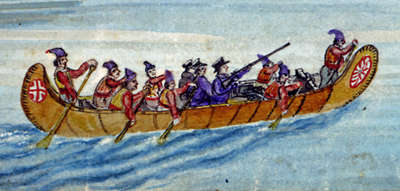 |
The large voyageur canoe was a preferred means of travel during the construction of the Rideau Canal. Cropped section from "Upper Rideau Lake" by Thomas Burrowes, 1830, Archives of Ontario, C 1-0-0-0-34
|
Water levels were lower in the pre-canal era, so they didn′t enter the main body of the lake until they passed the rocky point at the south end of today′s Murphys Bay. Here they encountered the full fury of the wind howling down the length of the lake. The white-capped waves whipped against the side of the canoe, rocking it dangerously. No problem for these experienced paddlers, they turned the canoe and headed up lake directly into the waves. The idea was to paddle up lake a ways and then make a quick turn, and run downwind, to the shelter of the shore and islands near the channel entrance to Davis′ Rapids.
It was on the turn to make the downwind run that they got into trouble. Was it a mistake of the paddlers? Perhaps they misjudged the waves? Whatever the reason, the canoe was hit by a series of large waves at the critical point in the turn. The waves crashed directly broadside, the men and cargo were thrown sideways and the canoe flipped over. The men hung onto the canoe for dear life, but the cargo, the barrel of coins, plunged to the depths of Opinicon Lake.
The men were lucky, the water was warm and the wind blew the canoe, with the men hanging on, to shore. Wet and bedraggled, they made their way back to Chaffey's Mills to report the mishap. The only location for the missing barrel of coins that they could provide was "in deep water, somewhere off-shore from the rocky point." Later, this point would become known as Barrel Point.
John Redpath, when informed that his coins were now on the bottom of Opinicon Lake and that his men would have to wait another couple of weeks until new coins could be shipped, was heard to mutter "I told them so." Redpath had lobbied to be allowed to pay his men by cheque drawn on the Commissariat Department, to avoid the dangers of transporting coin from Bytown to the worksites. His request was turned down with the explanation that "the adoption of this proposal would embarrass the system of account."
Redpath was doubly upset at the loss since, as per the rules established by the Commissariat for all the contractors, he wouldn′t get paid for the work completed at Jones Falls during the last month until he proved that his men had been paid. So, not only were his men unpaid, but Redpath himself would remain unpaid until he could secure another barrel of coins.
To mollify his unpaid men, Redpath provided double rations of rum, while waiting for a new shipment of coins to arrive.
Attempts were made to find the lost barrel, but the technology of the day (dragging the bottom with grappling hooks and nets) precluded being able to properly search the depths, and the barrel of silver coins was never recovered. The coins remain on the bottom of Opinicon Lake to this day.

There are many variations of this tale, but all refer to missing treasure, usually silver coins. Some of the other tales are:
A barrel of silver coins was stolen by one of the men and buried. This man was later found dead along the road – the cause of his death and the location of money remain unknown. Another story claims that the workers identified the culprit who stole their pay and murdered him, unfortunately (for them) before he revealed the location of where he had buried the coins.
In another version, the story starts with the pay being shipped overland to the various stations from Bytown. A few of those in charge of pay at the stations were a bit crooked and were skimming the payroll. When authorities became suspicious an investigation was launched. Those guilty buried their hoard and fled south to the U.S., never to return. The money has never been found [or has it? See “The Facts” below]. This is said to have taken place at either Davis Lock, and/or Jones Falls and/or Long Island and/or Smiths Falls and/or Rideau Ferry and/or Hartwells.
Some say that the story relates to the payout of Walter Davis Jr., the owner of the sawmill at Davis' Rapids (now Davis Lock). Colonel By bought Davis out in 1829, to allow the lock and dam to be built in the location of Davis' sawmill and mill dam. Davis was apparently paid in coin, but given the lack of any nearby bank, he followed the custom of the day and buried the money for safekeeping on his property. He died in 1830, without revealing to anyone the location of his buried treasure. It remains buried near Davis Lock to this day.
In his book, "Fish Tales," Ed Bebee relates a version of this story as taking place at Jones Falls. An old settler at Jones Falls sold his property for as much money (in silver coins) as he could carry away. He was given a sack full of coin which he staggered away with. Reaching the summit, the weight became too much, so he hid the coins in a cleft in the rock. He staggered home but died that very night from his overexertions. The coins have never been found.
The Facts
Which version, if any, is true? Mention of a lost shipment of coins isn't evident in any of the records of the day (no Rideau researcher has ever mentioned coming across a direct reference to this). However, the fact that silver coins were being shipped along the Rideau during its construction is absolutely true. Given the amount of silver that was transported from the Commissariat in Bytown to the work sites, the likelihood that some was stolen is rather high.
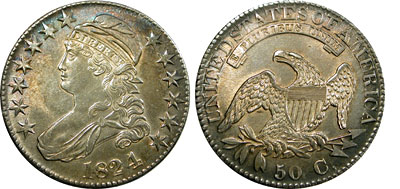
Although the contractors were paid by cheque (drafts payable in Montreal), payment for the contractors' men had to be made in cash. There was a mix of money at the time. John Mactaggart explained this in 1829: “The money in circulation is chiefly what is called dollar-bills, being provincial bank-notes, and Yankee half-dollars, which are about the size of half-crown pieces; silver coins having eagles, stars, and emblems of liberty stamped upon them. British coins are very rare, and are eagerly inquired after ; a sovereign is worth 24s. currency.”
Yankee Half-Dollar
American Half-Dollar coins similar to
those used to pay the workers (source: Wikipedia).
In terms of payment of the contractors' workers, Mactaggart stated: “All the labourers on the Canal were paid in Yankee half-dollars ; the commissariat furnished these to the contractors, brought up in boxes from Montreal. It was curious enough to see the contractors crawling through the woods with their dollar-bags on their backs. Poor fellows! the trouble Government found in making ready cash payments involved many of them in great distress.”
The contractors complained about this system and would have preferred to pay their men by cheque, but, as mentioned in the first story, the Ordnance Department turned them down, stating that “the adoption of this proposal would embarrass the system of account.” In order to protect the interests of the workers, the Commissariat (business office of the Rideau Canal during construction) delayed payment to the contractors until it was satisfied that they had settled all outstanding pay with their men. It was a good check and balance system, ensuring that all the workers were properly paid, but it also meant that a lot of silver was being shipped along the Rideau.
How much silver was shipped? We don't really have any idea but we can do some basic math. A quick way is to take the total cost of construction (£822,804) and assume that about 1/3 was direct labour costs paid in silver. We come up with 2.2 million half-dollars, or 435,000 coins per year for each of the 5 full years of construction.
Another estimation can be made based on the number of men who worked every year on the Rideau. The problem is that we don't know how many men there were, estimates vary from 2,000 to 3,000 and these numbers don't represent the number for a full year (crew sizes varied by season). The average day-rate wage for a labourer was 2s 6d (2 shillings, 6 pence or half a crown or 1 U.S. half-dollar). This was later raised to between 3 and 4 shillings. Pay for skilled trades ranged from 5s per day for a carpenter to 7s per day for a stone mason. We don't know how many there were of each, but we could guess about 3/4 labourers and 1/4 tradesmen since it was a manual labour intensive job. If we take 2,000 men and assume that they all worked 6 days a week during the year (312 days) – we come up with about 850,000 coins per year. That's likely far too high (it would represent 65% of the total construction costs) – probably because the assumption that they all worked 312 days per year is in error. But, looking at the two calculations, we might assume that in the order of 500,000 coins were being moved along the Rideau during each year of construction.
How were they actually moved? Mactaggart describes the contractors crawling through the woods with dollar-bags on their backs, but that wasn't the case. There were paymasters at each station and it was their responsibility to get the silver safely to the worksite. The coins were shipped both overland (on the better roads in the more travelled sections of the Rideau) and by water (to the more remote worksites). In the first story, it is suggested that the contractors, at least those at Chaffeys (Haggart), Davis (Drummond) and Jones Falls (Redpath), joined forces to do a single shipment – but they may well have each done their own.
We do have some stories from the paymasters. The May 7, 1926 edition of the Ottawa Citizen carried an article with the title “Shiners Attacked Canal Paymasters for Kegs of Silver.” The article recounts a story by Captain Stephen Collins, as handed down through the Collins family. Collins was a farmer in Nepean Township. When the canal project started, farmers along the route took various jobs. Collins became paymaster for the section between Black Rapids and Manotick.
In one incident, Collins describes paddling from Bytown with a keg of silver in a birchbark canoe. At some point, he realized that he was being followed by another canoe with three men in it. They were described as “Shiners” (Irish ruffians) in the story, but that term didn't come into use until after the canal was built and battles in Bytown between the Irish and French-Canadians for control of labour for the timber trade started. But, whoever they were, they were clearly after him so he paddled for dear life and turned into a gully. Then, out of sight of his pursuers, he dumped the keg of silver overboard and paddled to shore. The men chasing him saw him land on shore and shouted for him to stop, but Collins ran off. The men fruitlessly searched Collins' canoe and the surrounding area for the silver. Collins returned with help the next day, fished out the keg of silver and the men were paid.
In another story in the same article, it is recounted that he was travelling on foot with the silver coins in a shoulder bag when he saw two men approaching him. He put the bag on the ground and sat down on it, pretending to be a tired wayfarer. The men approached and tried to talk to him, but he just kept his head down, not answering. The men exclaimed “that's not him” and went on.
The November 12, 1932 edition of the Ottawa Citizen carried another article about silver being transported on the Rideau. This was recounted by James Barrett (who was 98 at the time) about his father Peter Barrett. Peter was from Castlebar, Ireland, a shoemaker by trade. He came to Bytown in about 1827 and took a job on the canal. The job involved carrying silver to the worksites. According to the article “The pay was nearly all in silver, mostly in American [half] dollars. It was the boast of Peter Barrett that though he had carried many thousand of dollars on horseback long distances up the canal he never lost a dollar.”
So, other than tales that money was lost, did any really go missing?
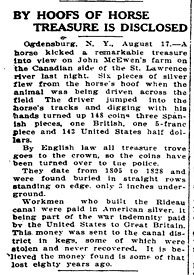
There is interesting information that at least some stolen silver was found, lending credence to the stories. The August 18, 1912 edition of the Atlanta Constitution ran an article with the headline: “By Hoofs of Horse Treasure is Disclosed.” The article reads as follows:
“Ogdensburg, N.Y., August 17 -- A horse kicked a remarkable treasure into view on John McEwen's farm on the Canadian side of the St. Lawrence River last night. Six pieces of silver flew from the horse's hoof when the animal was being driven across the field. The driver jumped into the horse's tracks and digging with his hands turned up 148 coins, three Spanish pieces, one British, one 5-franc piece and 143 United States half dollars.
By English law, all treasure trove goes to the crown, so the coins have been turned over to the police.
They date from 1805 to 1828 and were found buried in straight rows standing on edge, only 3 inches underground.
Workmen who built the Rideau canal were paid in American silver, it being part of the war indemnity paid by the United States to Great Britain. This money was sent to the canal district in kegs, some of which were stolen and never recovered. It is believed the money found is some of that lost eighty years ago.” |
 |
Given the reference to the coins in straight rows, standing on edge, we might assume they were buried in a container that allowed neat stacking (i.e. a wooden box) that rotted away, leaving the coins in rows. The dates on the coins certainly point to the canal construction era and the article's conclusion that these coins were stolen from silver used to pay the workmen on the Rideau is most likely correct.
Is there still silver to be found below the soil or the waters of the Rideau? Some people have been convinced by this tale of missing silver, and, given the previous article, they may well be right. The September 30, 1953 edition of the Ottawa Citizen ran an article with the title “Retiring Civil Servant to Dig Buried Treasure.” It was the story of retiring Hartwells' Lockmaster Allan C. Moses, who was planning to dig for buried silver. He believed stories that a great deal of silver was stolen from a paymaster's house at Hartwells (an old log house at the lockstation that still existed in 1953). He hinted that he knew where some of the stolen silver was hidden. He also claimed that he knew of buried treasure at Stone House Point (Lower Rideau Lake) and at Jones Falls. It's unknown if Mr. Moses was successful in his endeavour to pad his government pension with silver.
Is there still silver to be found?
You now have some of the facts – you be the judge.
Sources:
Atlanta Constitution, August 18, 1912.
Bebee, Ed, Fish Tales, The Lure and the Lore of the Rideau, Friends of the Rideau, 2007.
Bush, Edward F., The Builders of the Rideau Canal, 1826-32, Manuscript Report 185, Parks Canada, Ottawa, 1981
Churchill, G. Clare, Rideau Reflections, 1000 Island Publisher, abt. 1992.
MacTaggart, John, Three Years In Canada, two volumes, London, 1829.
Ottawa Citizen, May 7, 1926; Nov. 12, 1932 & Sept. 30, 1953.
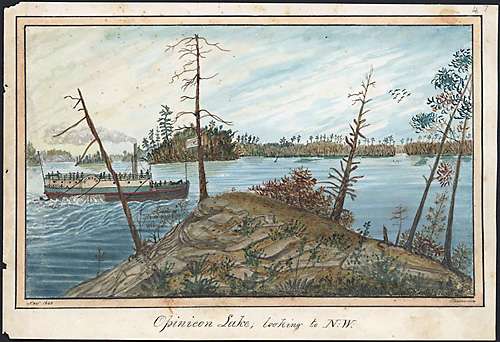 |
The steamboat "Hunter" passed in front of a rocky point in Opinicon Lake, today called "Barrel Point." Is this the location where the barrel of silver coins was lost? "Opinicon Lake looking to the N.W." by Thomas Burrowes, 1840, Archives of Ontario, C 1-0-0-0-47
|
|