Learn the history, relax with nature, experience its charm – SAFELY
GENERAL
Rideau Canal employees are on site between mid-May and mid-October during
operating hours (see Hours of Operation and fees). There
is at least one staff member trained in first-aid and CPR, ready to help and/or
contact emergency services in case of an emergency. While at a lockstation, talk
to the staff about possible hazards of the site and discuss any safety concerns
you may have.
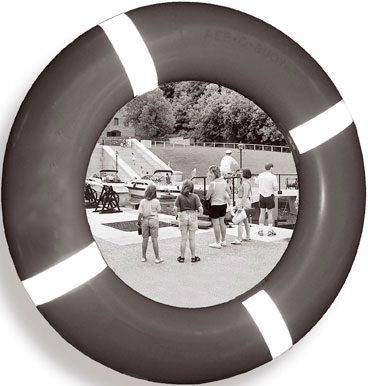
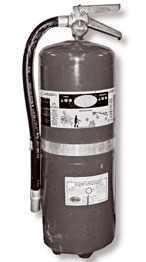
Safety equipment at a lockstation includes fire extinguishers, life rings and
a first-aid kit. However, the lock building and equipment is secured after
operating hours. The life ring is left accessible, but is to be used only in the
case of an emergency, not for any kind of recreational use – this ring could
save a life.
Communication with emergency services is made available during operating
hours only. Although there are public phones in the vicinity of some
lockstations, this is not always the case. Visitors should carry a cell phone
and dial 911 when lockstaff are not available. Cell phone reception can vary
from one location to another so check with the staff on site.
In case of emergency, it is imperative that you are able to clearly and
specifically identify your location to emergency rescue services. Preparing
yourself with this information in advance, in case of an emergency, could save a
life.
Maintenance of a lockstation is an on-going requirement. While on site, be
aware of work in progress (e.g. temporary closure of an area for repairs, or
slippery floors in washrooms after being mopped). Immediately notify staff of
any safety-related maintenance issues you feel require attention. We appreciate
your assistance in keeping our lockstations safe.
LOCK CHAMBERS AND LOCK OPERATION
We invite you to read our brochure How A Lock Works, available at all
lockstations. Locking a boat through a lock is a fascinating process. While
watching a lockage, please:
- Stay clear of the lock operating devices (gate and sluice crabs);
- Watch your footing along the sides of the lock to be sure not to trip over
cable anchors;
- Do not lean over the water; open sluice valves create excessive turbulence
in the lock, increasing the risk of drowning if someone were to fall into the
lock;
- Be sure of your footing and hold the railing firmly, while crossing to
the
other side of the lock, on top of the lock gate; and
- Because fumes may accumulate in the lock chamber, do not smoke.
CHILDREN AT LOCKSTATIONS
Young children enjoy visiting a lockstation. It is an ideal place to picnic,
play and watch boats. Caregivers must be aware however, that although the
lockstation has a park-like atmosphere, it is a functional lockstation and with
that comes some definite hazards. In particular, there is the obvious risk of
falling into a lock chamber, either from the side of the lock or while crossing
a lock gate. A less obvious hazard is the sluice crank – while under pressure,
the sluice arm, if released from its hold has the power to fatally injure a
small child.
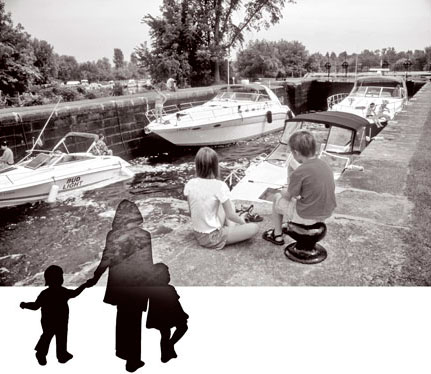 Merrickville© Parks Canada / Brian Morin / August 2003
Other considerations include such things as protecting your children from
excessive exposure to heat and sun, and how to safely approach a dog on a leash,
if you choose to allow them this freedom.
For their safety:
Children should not be at a lockstation without parental/caregiver
supervision at all times.
SWIMMING
While there is no formal definition for the term heat wave, we all know what
it feels like – hot, humid and energy sapping. It is only natural that during
these times, people search out ways to cool off. Swimming is one good option,
but swimming at a lockstation or around a dam is not. Swimming in the
navigation channel is like playing in the traffic on a busy street.
Boat operators may not see you and you therefore risk the boat running into or
over you, causing major injury or drowning. Even at times when there is little
or no boat traffic, you must still consider the following:
- Zebra mussels line the walls of the lock chambers, basins and docks. Their
shells can easily cut your hands and feet as you attempt to climb from the
water;
- Clam shells and other debris on the bottom may be sharp and cause injury
to your feet; and
- Stormwater pollution in urban areas, particularly after heavy rains, may
cause unsafe levels of E.coli bacteria in the water. Parks Canada does not
test canal water for bacteria levels to ensure they are safe for
swimming.
Swimming near a dam is very dangerous. (See section on Water
Control Dams).
It is illegal to dive, jump, scuba-dive, swim or bathe in a navigation
channel or within 40 m of a lock gate or a dam in a historic canal.
WATER CONTROL DAMS
Stay Clear, Stay Safe: Dams are not safe places for recreation or
fishing.
A spot that looks calm and safe one moment can become dangerous within a few
seconds as water levels and flows change, often without warning. Water above
dams is particularly dangerous as excess water is released through the dam; the
fast-moving water creates dangerous turbulence and strong undercurrents. The
draw of the dam could act as suction, trapping you against the structure below
the surface, causing death.
DOMESTIC ANIMALS
Pets are part of the family and are welcome at the lockstations. However, for
the comfort and safety of others and the safety of your pet, we ask you to do
the following:
- Keep your pet restrained by a leash no longer than 3 m (or confined in a
container or enclosure);
- Dispose of its excrement in a manner that does not annoy or inconvenience
other visitors;
- Ensure the behaviour of your pet does not interfere with other visitors’
enjoyment of the site; and
- Be sure it does not harass wildlife (e.g. birds, squirrels, groundhogs and
chipmunks).
CAMPING
Lockstations are not designed to accommodate camping. There are no designated
campsites or showers and only limited waste management (holding tank)
capability. Therefore, camping is restricted to boaters and organized cycling or
hiking groups under the authority of a valid permit.
FIRES
Ground fires are not permitted except in BBQs. Many lockstations provide BBQs
for visitors’ use, or you can bring and use a personal BBQ.
However, if it is not gas or propane, please check with lock staff on how and
where to dispose of the coals.
ALCOHOL RESTRICTIONS
The possession and consumption of alcoholic beverages is governed by the
Liquor Control Act. Possession and consumption of open liquor is
permitted only in licensed premises, a residence or a private place. Consumption
of alcoholic beverages is not permitted on Parks Canada property, including
docks and picnic areas.
STROLLING & HIKING
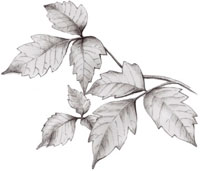 ‘Leaves of three, let it
be’© Parks Canada
‘Leaves of three, let it
be’© Parks CanadaFresh air, exercise, nature and historical viewscapes are some of the reasons
why recreational strolling is popular at Rideau Canal lockstations. While
enjoying the site, there are a few things to be aware of:
- Watch underfoot for ‘sink holes’. These are areas of ground under which
the movement of water causes the ground to erode, leaving a hole or trench.
This most commonly occurs along the stone wall lining the waterway but could
happen almost anywhere near the water;
- Uneven surfaces are not uncommon, particularly various types of stone
surfaces. Proper footwear and sure footing will help prevent the possibility
of injury;
- Poison ivy is found in many habitats, from woodlands to fields and can
grow unabated in poorly tended areas such a roadsides or paths. Hikers should
learn to recognize this plant in its various stages. An encounter can lead to
minor discomfort or even to serious medical problems. Consult the web for
excellent photos. Books on wildflowers and shrubs can also be helpful. Best of
all, hike with someone who can identify the plant and work at recognizing it:
‘Leaves of three, let it be’
- Sun exposure or dehydration is a risk in hot weather. Be sure to wear sun
screen and drink plenty of water.
FISHING
Historic Canals Regulations prohibits fishing within 10 m of a lock
or approach wharf. For safety reasons, this regulation must be strictly adhered
to when there is a risk to other visitors, when boats are moored in the area or
while they are ‘locking through’. At other times, and at the discretion of the
lockmaster, fishing may be allowed within the controlled area.
Fishing from a water control structure (dam) or from a bridge over a
navigation channel is prohibited. Both federal and provincial laws regulate
fishing in Ontario. To help protect and conserve fish and fish habitat, and to
avoid possible fines, become familiar with the Recreational Fishing Regulations
available from the Ministry of Natural
Resources.
POTABLE WATER
Potable water is available at all lockstations. The water is tested on a
regular schedule in accordance with Parks Canada Water Quality
Guidelines. Occasionally an adverse water test requires the water to be
boiled before use. A sign is posted at the water source, to warn visitors of
possible health hazards until the deficiency can be rectified.
RESPECT the canal, its plants/animals and other people.
Do not:
- disturb or feed wildlife;
- damage or destroy trees or plants;
- pick or collect natural or historic objects;
- litter
HAVE A SAFE VISIT !



 Lockstation Safety