Your location: Rideau Canal Home Page > Rideau200
RIDEAU200
The 200th Anniversary of the Opening of the Rideau Canal
|
|
The Rideau Canal has been open for: Timer |
The Rideau Canal was completed in 1832. The first steamboat transit was done in May, with the steamboat Rideau (aka Pumper) leaving Kingston on May 22 and arriving in Ottawa on May 29. The first commercial trip was also done by the Rideau/Pumper which left Kingston for Bytown on July 12, 1832 carrying 200 barrels of flour, 60 barrels of pork and an unknown number of passengers.
The Rideau Canal is the oldest continuously operated canal along its original line in North America. This is part of the reason for its UNESCO World Heritage Designation.
In 2032 we will be celebrating the 200th Anniversary of the opening of the canal. There will be lots of activities and projects to commemorate this milestone. This page will provide information and links to those activities and projects.
Stay tuned.
Milestone Dates:
- September 9, 1826 - The Commanding Royal Engineer in Canada, Colonel Durnford, received specific instructions for Lt. Colonel John By to proceed with the building of the Rideau Canal.
- September 21, 1826 - Lt. Col. By arrives in at Wright's Town (Hull), with several of his staff, including Lt. Henry Pooley, and proceeds to examine possible spots to start the Rideau Canal. They choose what is today Entrance Valley in part due to its defensive advantages, with a hill (today's Parliament Hill) overlooking the valley and the existence of a beaver meadow at the top of the valley, an ideal spot to create a lay-by for the canal.
- September 25, 1826 - Lt. Colonel John By and George Ramsay, the 9th Earl of Dalhousie and the Governor-in-Chief of British North America, examined Entrance Valley and the character of the land between it and the Rideau River, agreeing that it was the best spot for the start of the Rideau Canal.
- September 26, 1826 - On this date, Dalhousie handed a letter to Col. By stating that he was providing By with sketches of lots of land he'd purchased in that area, which included Entrance Valley. The letter encouraged By to lay out lots for a townsite. He also authorized By to erect a series of bridges across the Ottawa River at Chaudiere Falls. This is considered to be the founding of Bytown, later renamed Ottawa (1855).
The letter is shown below:
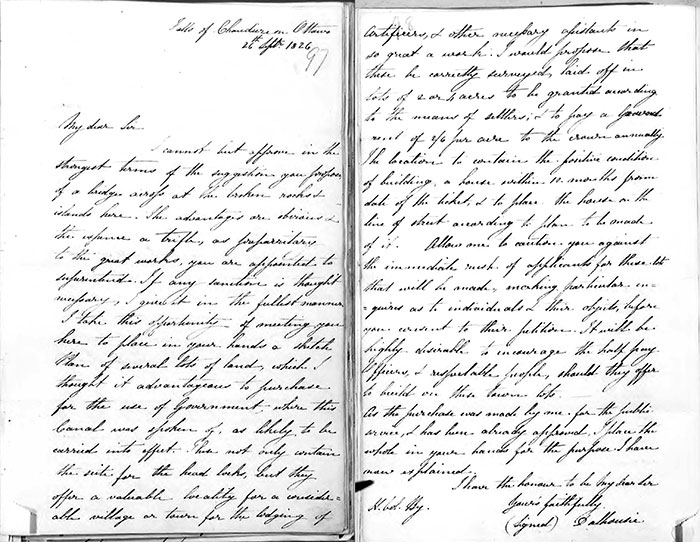
(from Library and Archives Canada, RG8-I, Volume number: 42)
Falls of Chaudiere on Ottawa
26th Sept 1826
My dear Sir
I cannot but approve in the strongest terms of the suggestion you propose of a bridge across at the broken rocks & islands here. The advantages are obvious & the expense a trifle, as preparatory to the great works you are appointed to superintend. If any sanction is thought necessary, I give it in the fullest manner.
I take this opportunity of meeting you here to place in your hands a sketch plan of several lots of land which I thought it advantageous to purchase for the use of Government, where the Canal was spoken of as likely to be carried into effect. These not only contain the site for the head locks, but they offer a valuable locality for a considerable village or town for the lodging of Artificers, & other necessary assistants in so great a work. I would propose that these be correctly surveyed, laid off in lots of 2 or 4 acres to be granted according to the means of settlers, & to pay a Ground-rent of 2/6 per acre to the Crown annually. The location to contain the positive condition of building a house within 12 months from date of the ticket, & to place the house on the line of street according to plan to be made of it. Allow me to caution you against the immediate rush of applicants for these lots that will be made, making particular enquires as to individuals & their objects, before you consent to their petition. It will be highly desirable to encourage the half pay Officers, & respectable people, should they offer to build on these town lots.
As the purchase was made by me for the public service, & has been already approved, I place the whole in your hands for the purpose I have now explained.
I have the honour to be My dear Sir
Yours faithfully
(Signed) Dalhousie
Work subsequently started on clearing the valley of trees and surveying the area from Entrance Valley to Hogs Back.
- 1827 - Lt. Colonel John By, the Superintending Royal Engineer for the project, divides the Rideau in to 23 sections with the intent of assigning each section to an independent contractor. In May 1827, he does his first transit of the Rideau Route by canoe, checking out each proposed lock site. Work starts on various sections and by the end of the year work is being done along the entire length of the Rideau Route.
- 1827-1831 - Battling disease and difficult working conditions, a diverse group of people laboured to build the canal. Plans had to be changed to meet conditions and several contractors quit forcing Col. By to take over two of the sites (Hogs Back and Newboro) using his Sapper and Miners along with civilian workers. Several other sites were re-contracted to existing contractors.
- June 1828 - the Rideau was originally to have locks 108 feet long by 20 feet wide, but Lt. Col. By lobbied for larger locks, 150 feet wide by 50 feet wide. A committee under Sir James Kempt was formed to study the issue and in June 1828 settled on the lock size we have today, 134 feet long by 33 feet wide. Existing locks were torn down and plans changed to accommodate this larger locks size.
- Fall 1831 - The northern section of the canal was completed with a steamboat going through the Ottawa Locks and getting as far south as Clowes. The Royal Sappers and Miners are disbanded in December 1831. Most stayed in Canada, taking offered land grants and many became the first locksmasters. Work continues on several of the southern lockstations to have them ready by spring 1832.
- May 1832 - The first steamboat transit of the canal, from Kingston to Ottawa is done with Lt. Col. John By and family aboard. The trip was done on the steamboat, Rideau (nicknamed Pumper), which departed Kingston on May 22, 1832 and arrived in Ottawa on May 19 with many celebrations along the way. The southern locks are still being worked on and it wasn't until July 1832 that the Rideau opens to commercial traffic.
 Comments: send me email: Ken Watson Comments: send me email: Ken Watson
This site was originally created on August 30, 1996
and has been providing people with information about the Rideau Canal for:
©1996- Ken W. Watson
 Don't be shy. Click on the flag
|