Rideau Canal Waterway title

LEVEL HEADED
by
Charles Long
 
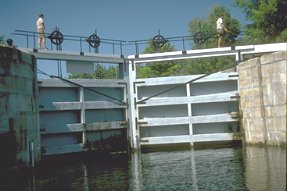
canalmen on lock gate
Canalmen on top of lower lock gates
Ron Sosnick has one of those 19th-century jobs that seem to appealing as urban life gets complicated. When a boater wanders down the Tay Canal from Perth, Ron – the lockmaster – and his canalman, Ken Bruyere, crank open two pairs of wooden gates by hand. The boater waves, and putters through Beveridges Bay into Rideau Lake. Or vice versa if Rideau cottagers want to cruise five miles up to Perth for some shopping or a fancy meal. Sixteen hundred boats a year. On good days, the grass is green, the sky is blue, and a little waterfall from a leaking gate plays flute in the songbird symphony.

Other days aren’t quite so idyllic, starting in 1890 when the nearly completed Tay cul-de-sac of the Rideau took a shot from Sir John A. Himself. After an MP told the House that the Tay drained Perth, Macdonald cracked that it drained the public treasury as well. Another member attacked the first year’s revenue ($58.81) as "a screaming farce … a living monument of departmental imbecility."

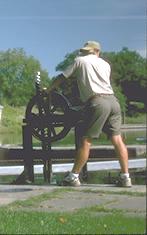
canalman opening sluice
Canalman wearing snazzy Parks Canada uniform (and opening sluice gate)
Public works have always been a public target, no matter which century or how sweet the setting. And the lockmaster, notwithstanding the fact that he wears shorts to work and would rather not wear the socks that are part of the uniform, is…ahem…a public servant. He hides it well, but that $58.81 must still rankle.

Sosnick took over the two Beveridges locks in 1988, after about 20 years working busier stations along the main channel of the Rideau. "The Tay was my challenge," says the effervescent lockmaster. "It was so quiet here." He fixed up the old mud-bottomed boat launch and turned it into a moneymaker, invited campers to stay, made the washrooms wheelchair accessible for the Easter Seal camp next door, and became such a key part of the summer community that the Beveridges Bay Cottagers Association now donates $100 a year to the lockstation. In addition to the two locks and the dam that maintains navigable water levels, the lockmaster and his staff operate a swing bridge, maintain the turning basin where the canal ends in Perth, look after a Crown-owned island in the Rideau, tend the flowers, and mow 20,000 square metres of grass. Beveridges, with the fewest boats through the Rideau’s 24 lockstations, now ranks number 11 in the revenue column. Stick that up your drain, Sir John.

Although the Rideau Canal was designed to move troops and supplies from Montreal to the Great Lakes without exposing them to American guns, its military purpose was never met. Instead it became a commercial waterway, and then a recreational artery. The Tay spur came one step later. Designed as an improved commercial link for Perth to the Rideau, the Tay’s purpose was undercut by the railway before it opened. Instead, the little canal met the cottage boom at the beginning and has been in the recreation business ever since.

Fifteen-year-old Fred Dickinson spent his very first summer beside these locks in 1904. On August 24th he wrote "…went for a swim in the canal and had a fine time on the raft that belong to the locks…we three turned summer-saults and dove off it." (From A Boy’s Cottage Diary by Larry Turner, 1996). The lockmaster admits that the local kids still swim here.

Swimming? In the Crown’s canal? Surely there must be a rule. Sosnick’s quick grin acknowledges some ambiguity on what constitutes a problem and how to solve it. He prefers the personal approach. "Like those kids who were running their personal watercraft in here, roaring around doing ‘power turns.’ I just told them to hand me the keys. I had no right to do that. But they gave me the keys, I called their fathers, end of problem."

A lockmaster learns on the job. "I started when I was 19 as a summer employee at Poonamalie Lock," says Sosnick, now 46. "Then got on the dredge. Worked at Kilmarnock and Smiths Falls Combined. I just stayed with it." There is no computer in the lockmaster’s office, no fax, no copier. From 8:30 a.m. to 7:30 p.m. when the locks are open, he collects the fees, logs the day’s events on a clipboard hanging by the open bay window, and is otherwise equipped with experience and common sense to keep things running smoothly.

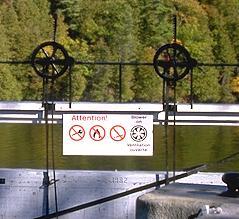
attention sign
Lower gates with "Attention" sign
The lock is simplicity itself. Stone walls and two wooden gates enclose a "lock" of water 90’ long and 28’ wide. The water level above Lower Beveridges lock, for example, is 12’ higher than the lake. The water level in the lock can be raised by opening a valve in the upper gate, or lowered by opening a valve in the lower gate. A boater approaching from the lake motors into the lock, loops mooring lines to the wall, and shuts off the engine. The lockmaster and his canalman turn the clattering chain winches that swing the two halves of the lower gate closed. Then they open the valve in the upper gate and let the lock fill with water. When the water inside the lock matches the level above the lock, they winch open the two halves of the upper gate and the boater continues upstream to the next lock, Upper Beveridges, where the process is repeated and the boater is raised another 13’. Now the upper gate is open, and boats headed downstream can manoeuvre in. Reversing the order of the gates and valves, the canalmen let a combined 25’ of water out of the two locks, then crank open the gates to the Rideau.

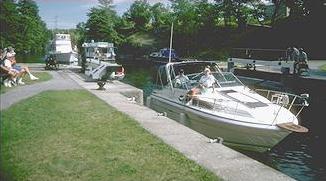
boats entering lock
Boats entering lock
Although the lockmaster’s tools are made of iron, wood, and experience, the passing boats carry high-tech prices and amateur crews. "You can have $2 million dollars worth of hardware sitting in the lock," says Ken Bruyere. "You gotta know what you’re doing." The rush of water that fills the lock can set up unexpected currents, banging a poorly moored boat into the wall, or into another expensive boat.

"The cottagers are pretty good," says Sosnick. "Most of them have taken the Power Squadron courses or know what they’re doing from experience. The rental boats are worst because the renters just don’t have that experience. They’re better off by themselves in there."

The consequences can be serious. One nearby lock has a low bridge near the entrance. Once, a careless boater in high captain’s chair hit the bridge at chest level and was knocked to the deck. The ambulance crew arrived in a hurry, but somehow – in the process of passing the injured man from the boat to the top of the lock wall – somebody let go of the mooring line in order to grab the shore end of the stretcher. The boat drifted inexorably away from the wall…more than a stretcher length away from the wall. The ambulance attendant recalls that the 15’ of water in the lock was clear enough to see the expression on the boater’s face as he sank below the surface still securely strapped to the stretcher. They dove in, helped the victim out, and got him to the hospital, where he suffered a fatal heart attack a few days later.

Beveridges’ own day of drama involved a rescue of another kind – a stand-off to save the ospreys. "Hydro showed up to tear down a nest on top of their pole," Sosnick recalls. "They were just big birds to me, but when I asked the hydro guys what they were doing, they showed me this nest and it had three big, brown eggs in it. ‘I don’t think you should tear this down’ I said. They insisted they had orders to tear it down, so I gave them another order not to tear it down. I didn’t have the authority to make it stick, but they didn’t know that. They called their boss to come down and sort it out.

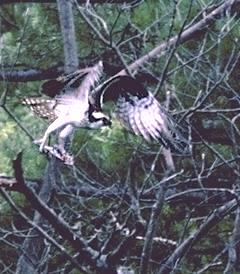
osprey in flight
Osprey taking flight
"In the middle of all this a van pulls up and there’s a camera and a TV newsman. ‘Are you Ron Sosnick?’ he asks. Well, Ken here…[Bruyere feigns innocence]…while I’m up the pole, Ken here had called the CBC, pretended he was me, and told them to get down here right away."

Between the hydro boss and the publicity, the ospreys won a reprieve – and a pole of their own. Their progeny now occupy a series of special poles, down the road.

One of the offspring who did stray back into hydro’s hot gear was, alas, transformed. The bird who proved such a poor conductor has, however, found his niche as a fierce-looking guard atop the lone filing cabinet in the lockmaster’s office. "Nice job, eh," says Sosnick, referring to the taxidermy. "You can hardly see the bullet hole…" He waits for a reaction, but the only visitor is the cottager from next door, and he’s heard the fib before. Instead, he goads Bruyere into telling the story of the romantic couple who thought the steep stone wall of the lock provided them with all the privacy they needed in a cabin cruiser. Had they not been so preoccupied, they might have notice that the rising water slowly lifted their window up the blank stone face of the lock, until it was replaced by the face of the bushy-bearded canalman.

Bruyere is more comfortable talking about the kids from Merrywood Easter Seal Camp next door. He designed a special two-legged picnic table for them, with room for wheelchairs instead of a bench. Bruyere and Sosnick buy the worms when the kids come fishing, and keep an all-terrain chair at the lock. Bruyere won a commendation from Parks Canada for his picnic table, and both he and Sosnick received a special Easter Seal award for their efforts.

There’s a family feel about the lock in summer. Between the Merrywood campers, the rented Lockmaster’s House, two other cottages on the lockstation grounds, and 20 more around the bay, it’s the kind of place where everybody knows your name (and knows your father if you misbehave on the personal watercraft).

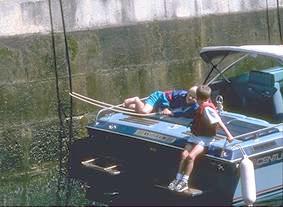
kids on boat
Kids holding line around drop cable in lock
The sense of family is doubly important to Sosnick and Bruyere. For a big part of their year, it’s the only family they have. "In June, July, and August we work 11 hours a day, six days a week," says Sosnick. That’s when summer students start. "Before the students arrive, we’re here seven days a week. It’s not a job, it’s a way of life."

"I’ve been on the locks 16 years," adds Bruyere. "Never had a summer vacation." Then in quick succession, not even trying to resolve the contradiction, Sosnick sums it up: "It’s a terrific job. You miss your family. I wouldn’t do anything else."


This article is reproduced here with permission of the author; Charles Long. Full copyright is retained by Charles Long and this article may not be reproduced in whole or in part without the expressed permission of the author.

This article first appeared in the the September/October 1997 issue of Cottage Life Magazine. Only the text of the article was used, the photos on this page are all ©1997 Ken Watson.
Home ButtonBack to the Articles Page

Comments: send me email: kwatson@kos.net
URL: http://www.rideau-info.com/canal/article2/level-headed.html
HTML © 1997 Ken Watson